
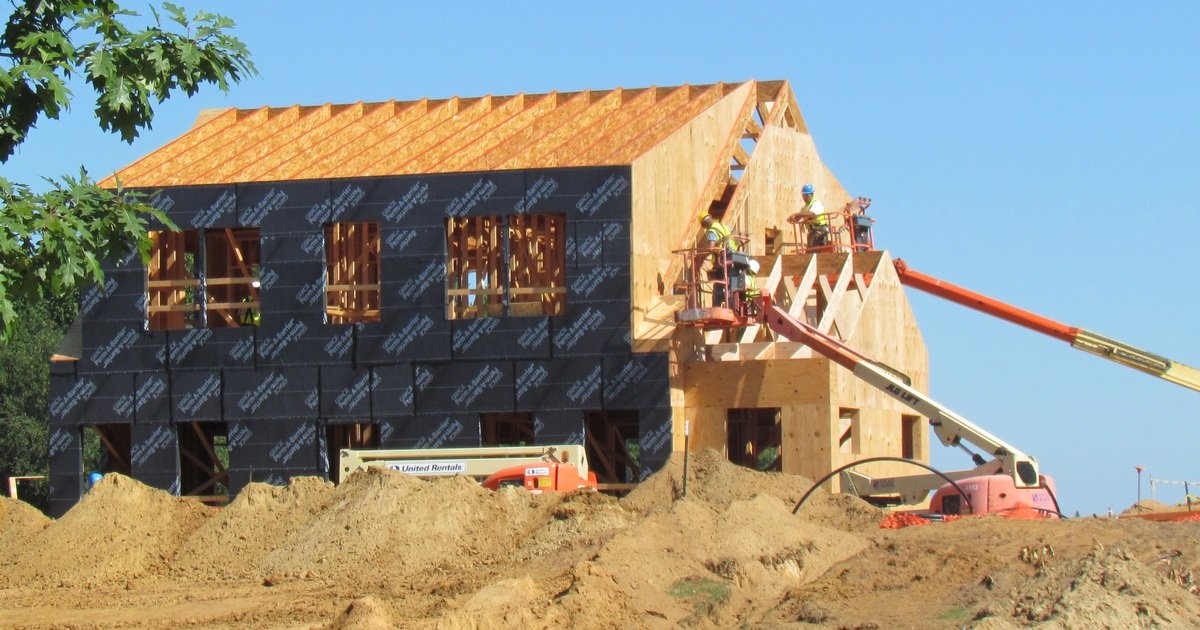
Photo: National Institute of Standards and Technology (NIST) / Wikimedia Commons, U.S. public domain; cropped and resized October 16, 2026. Illustrative new construction at NIST’s residential test facility—not an On Time Exteriors project or an example of damaged decking.

If a roofer finds damaged wood after removing your shingles, the right response is neither an automatic yes nor an automatic accusation. Ask what failed, where it is, how much must be replaced, and how the additional work will be documented. Roof decking replacement in Fort Wayne, Indiana should be a clear, evidence-based part of the project—not a vague surprise on the final invoice.
This guide answers one question: What should you do when your roof needs new decking after tear-off? It covers the hidden layer beneath the shingles, the limits of an advance inspection, and the questions to settle before work begins. For local help, start with our Fort Wayne roofing services.
What is roof decking, and why does its condition matter?
Roof decking, also called roof sheathing, is the structural surface beneath the underlayment and roof covering. Residential roofs may have plywood, oriented strand board (OSB), or boards. The deck provides a base for the roofing system and its fasteners; the rafters or trusses supporting it are separate components.
Replacing shingles does not automatically mean replacing every sheet of wood. But damaged material should not simply disappear beneath a new roof. GAF’s roof decking overview explains why the deck’s integrity matters and why its full condition may remain unknown until old materials are removed.
Why can roof decking replacement be discovered after tear-off?
An exterior inspection looks at a covered assembly. Attic access may reveal the underside of some areas, but insulation, finished ceilings, additions and inaccessible spaces can limit the view. A measurement of the roof’s area or pitch cannot establish the condition of wood hidden underneath.
Once old shingles and underlayment are removed, the contractor can examine the exposed surface. Localized rot around a penetration, deteriorated panel edges or previous patchwork may then become apparent. That discovery can be legitimate even if the roof looked reasonably flat from the driveway.
For a Fort Wayne home with an older main roof, a newer addition and an attached garage, ask whether each section was assessed separately. Do not assume a clean view in one attic establishes the condition of all the roof sections.
What evidence should the roofer show you?
- A location photo: enough surrounding roof is visible to identify the affected section.
- A close-up: the contractor explains the concern, such as crumbling wood, separation, a hole or loss of support.
- A measured scope: the number of panels or the area requiring work, with the charging unit stated clearly.
- A cause assessment: what is observed, what is suspected, and what still needs investigation.
A dark stain is a reason to investigate, not a complete diagnosis by itself. Ask how the material’s condition was evaluated and why the proposed boundary makes sense. GAF’s wood-rot guidance describes deterioration that can accompany moisture exposure, including softness, cracking and loss of strength.
Do not climb onto the roof to verify a soft spot yourself. Ask for documentation or arrange a qualified independent assessment if the explanation remains unclear. Stay outside the work zone while the crew has open decking.
Does every new roof need complete decking replacement?
Not necessarily. The question is whether the problem is isolated or widespread, and whether the remaining surface is suitable for the selected roof system. A few damaged areas and an unsuitable deck across an entire roof are different scopes.
If full redecking is recommended, ask the contractor to distinguish deterioration from another issue, such as unsuitable board spacing or an assembly that does not meet the roofing product’s installation requirements. “It’s old” is not a sufficient explanation on its own.
Also separate sheathing work from framing repairs. A proposal to replace plywood is not the same as repairing a rafter or truss. If structural concerns are found, ask who will assess them and how the revised scope will be confirmed.
Roof decking replacement in Fort Wayne, Indiana: estimate checklist
Before choosing a contractor, find the line that explains concealed decking work. If the quote only says “wood extra,” ask for more detail while the roof is still intact.
- Included quantity: does the base price include any decking, or is all replacement additional?
- Unit and scope: is extra work charged by panel, square foot, board length or another defined unit? Are labor, fasteners, removal and disposal included?
- Material: what type and specification will be used, and how will compatibility with the existing roof be checked?
- Approval: who can approve additional work, how will they receive photos, and how will the new total be recorded?
- Unknowns: what happens if framing damage or a larger unsuitable area is uncovered?
Keep the approval process practical. If you will be at work, agree on a reachable contact and an alternate before tear-off starts. Ask how the crew will protect the exposed area if an assessment or decision takes time. These are planning questions, not a request to accept an unlimited extra charge.
For the broader project scope, review our roof replacement information. This article does not set an On Time decking price; your written proposal should establish the applicable terms.
Plywood or OSB: choosing roofing materials for deck repair
Both plywood and OSB are used as roof sheathing. The decision should account for panel rating, thickness, support spacing, edge support and the roofing manufacturer’s requirements—not just which material name sounds better.
Ask the installer to identify the proposed product and explain how it fits your roof. APA’s roof sheathing installation guidance addresses the nailing surface, panel installation and the layers above it. Details are assembly-specific; a generic internet thickness recommendation is not a substitute for checking your structure.
Before covering the repair, request photos showing the replacement area. Retain those with the change order and final invoice so you have a useful record of what was installed.
Roof leak or attic condensation: what damaged the decking?
Replacing damaged wood is only part of the repair. Ask whether the problem came from a roof leak, a flashing detail, attic condensation or another condition. New sheathing is not a substitute for diagnosing the cause.
The Building America Solution Center explains how moist indoor air reaching cold attic surfaces can contribute to condensation. If the evidence points inside the assembly, an insulation or ventilation assessment may be needed alongside roofing work.
Also discuss weather protection during the project. Before installation continues, the contractor should evaluate exposed materials and follow the applicable product requirements. Ask what happens if rain interrupts the work rather than assuming the original completion estimate covers every condition.
What can old shingles tell you about the decking underneath?
Damaged shingles, repeated leaks or a visibly uneven roof are reasons to arrange a professional roof inspection. They do not establish a panel count from the ground. Granule loss is a shingle-condition indicator, not proof that every sheet underneath has failed.
Ask the roofer to separate surface wear and tear from hidden roof damage. A shingle repair may address a localized covering defect; extensive damage below the covering needs its own assessment. Likewise, an advertised shingle lifespan does not tell you whether the existing deck is suitable for reuse.
When comparing roofing services in Fort Wayne, request two explanations: why the old roofing needs work, and what is known about the wood beneath it. Roof size helps define the overall job, but it does not reveal how much concealed material is damaged.
Can you install new asphalt shingles over damaged decking?
Covering unsound wood does not restore its ability to support the roof covering and fasteners. Ask how the proposed repairs will restore the roof’s integrity before the next layers are installed. Keep the deck repair decision separate from upgrades to the visible shingles.
A short checklist before you approve the change
- I can identify the damaged location in the photos.
- I understand why repair or replacement is needed.
- The material, quantity, included work and added amount are recorded.
- I know whether framing or moisture-source work is separate.
- I know who is approving the change and how the roof will be protected.
For a Fort Wayne property, request an On Time Exteriors roof inspection to discuss visible condition and project-specific next steps. Already comparing complete roof replacement? Start with your address for a roof price, then confirm the decking allowance and final scope in the written proposal.